
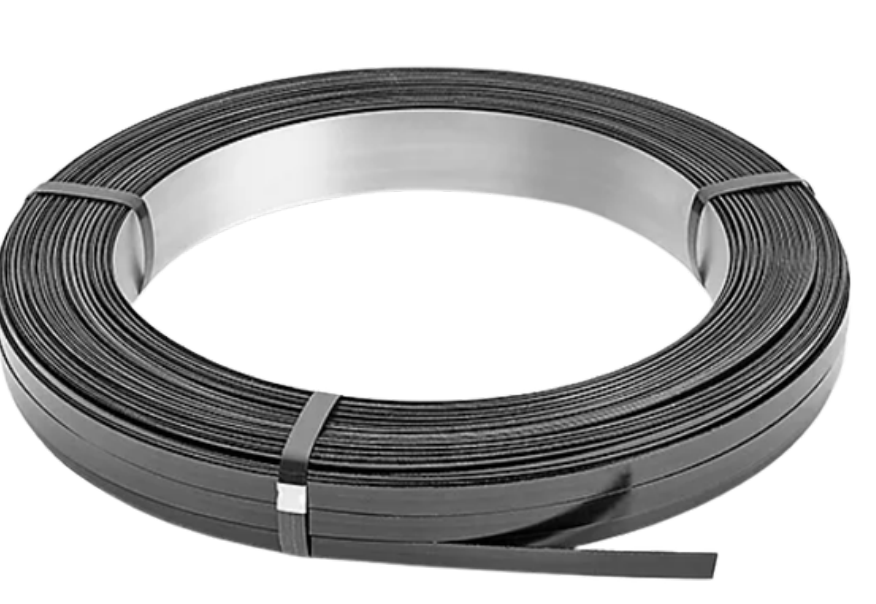
An empty coil rarely comes at a convenient time. It can happen in the middle of a production run, while finished loads are waiting or when an operator is already responsible for several packaging tasks.
Replacing the coil means stopping the station, removing the empty coil, loading the new one, threading the strap, and checking that it feeds correctly. The process may only take a few minutes, but the interruptions add up when they happen several times during the workday.
Oscillated steel strapping, also called traverse-wound strapping, gives high-volume operations a way to run longer between those interruptions. Its winding pattern places more continuous footage on a coil than a comparable ribbon-wound configuration.
Oscillated vs. Ribbon-Wound Steel Strapping
With ribbon-wound steel strapping, each wrap sits directly over the previous one. The finished coil resembles a roll of tape, with a face approximately as wide as the strap.
Oscillated strapping moves back and forth across a wider coil face as it is wound. It looks more like thread on a spool. The overlapping pattern allows a longer continuous length of steel strap to be wound onto the coil.
That difference affects how long a station can operate before the material runs out. It does not make the strap stronger. Break strength still depends on the steel grade, width, thickness, and other material properties.
Champion Strapping offers certain heavy-duty specifications in both winding styles. That makes it possible to compare the amount of strap on each coil without introducing a different width, gauge, or break strength.
What the Difference Looks Like in Actual Footage
Champion Strapping offers ¾” by .029” heavy-duty steel strapping in both oscillated and ribbon-wound configurations.
Both versions have:
- An average break strength of 3,350 lbs
- An average yield of 13.5 feet per lb
- A painted and waxed finish
The oscillated coil weighs approximately 100 to 105 lbs. The ribbon-wound coil weighs approximately 60 to 65 lbs.
Using the listed yield, the estimated footage is:
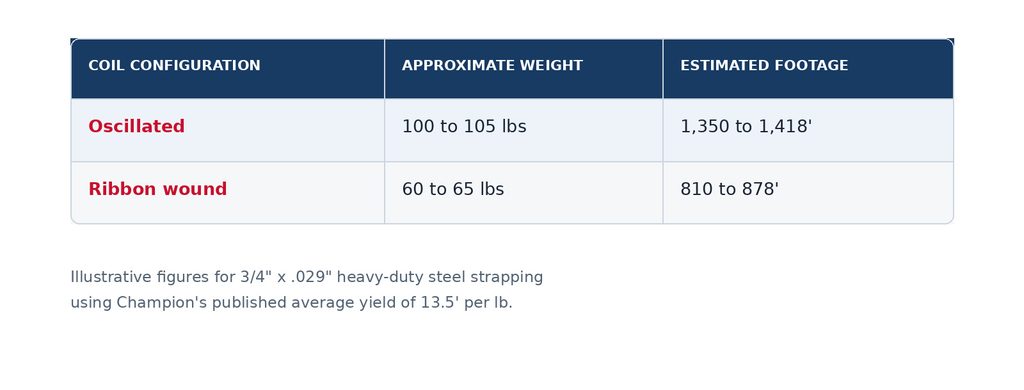
At either end of the listed weight ranges, an oscillated coil contains approximately 540 more feet of steel strap. That provides about 62% to 67% more footage before the coil needs to be replaced.
The value of that extra footage becomes clearer on a busy packaging line.
How Additional Footage Can Reduce Daily Coil Changes
Consider an operation that processes 200 loads per shift. Each load requires three 10-foot straps, and the line runs for two shifts per day.
Daily steel strap use would be:
200 loads × 3 straps × 10’ × 2 shifts = 12,000’ per day
At that level of use, the operation would consume approximately:
- 8.5 to 8.9 oscillated coils per day
- 13.7 to 14.8 ribbon-wound coils per day
The oscillated configuration could therefore reduce daily coil changes by approximately five to six, depending on the actual coil weight, usable footage, and operating conditions.
This does not mean every facility will eliminate exactly five or six daily changeovers. Actual change frequency depends on usable footage, when the first coil was loaded, material left on removed coils, setup practices, strap used during testing, and other operating conditions.
It does show why coil format matters. When a line consumes 12,000’ per day, adding approximately 540’ to each coil can materially reduce how often an operator has to stop and reload the dispenser.
Where Fewer Coil Changes Have the Most Value
Oscillated steel strapping is most useful when coil changes happen often enough to interfere with packaging work.
That may include:
- Manufacturing lines that apply steel strap throughout the day.
- Distribution operations processing heavy or rigid loads.
- Facilities operating across multiple shifts.
- Packaging departments with several active strapping stations.
- Operations applying multiple straps to each load.
- Metal, pipe, brick, block, paver, lumber, and building-material facilities.
- Stations using pneumatic or combination tools for repeated applications.
If your operation uses steel strapping at a lower volume and one coil lasts for days or weeks, switching to an oscillated coil may offer limited practical benefit. Ribbon-wound strapping may also be the right choice when the required width or gauge is normally supplied in that configuration. We offer several 1-¼” heavy-duty products in ribbon-wound coils.
Your daily or weekly strap consumption provides a stronger basis for choosing a coil configuration than load type alone.
Measure the Current Changeover Burden
A short review of current coil use can show whether a change in winding style is worth considering.
For several production days, record:
- Coil changes at each station.
- Time required for each change.
- Strap consumption by shift.
- Material remaining on coils removed before they are empty.
- Production waiting during the change.
- Feeding problems after a new coil is installed.
- Differences among stations or shifts.
The numbers do not need to be perfect. Even a basic record can show whether coil changes are an occasional task or a recurring interruption.
If one station changes coils several times per shift while another rarely does, the two stations may not need the same configuration.
The Dispenser Must Match the Coil
Changing from ribbon-wound to oscillated steel strapping may also require a different dispenser.
The selected dispenser must accommodate the coil’s:
- Face Width
- Inside Diameter
- Outside Diameter
- Loaded Weight
- Winding Style
We offer standard oscillated coils with a 2 ⅝” face, 16” inside diameter, 23” outside diameter, and approximate weight of 105 lbs. Ribbon-wound configurations have different dimensions and weights.
Those differences matter. A dispenser designed around a narrow ribbon-wound coil should not be assumed to accept a wider oscillated coil.
The way the dispenser is positioned also deserves attention. The operator should be able to pull and apply the strap without placing the dispenser in the path of forklifts, carts, loads, or other packaging work.
Tool Compatibility Still Comes First
A longer coil can reduce material changes, but it will not correct a mismatch between the strap and the tool.
Champion supplies manual, pneumatic, and combination strapping tools for a range of steel strap sizes and applications. Combination tools can tension, join, and cut the strap with one unit. Pneumatic tools may be appropriate for repeated applications at busy strapping stations with a suitable compressed-air supply.
Before changing strap or tooling, verify:
- Strap width and thickness.
- Regular-duty or heavy-duty grade.
- Required break strength.
- Load dimensions, weight, and shape.
- Joint and seal type.
- Tool operating range.
- Available compressed air.
- Operator movement around the load.
The strapping, dispenser, seals, and tools need to function as a complete system. Saving time on coil changes provides little benefit if the new setup creates feeding, tensioning, or sealing problems.
Give Champion Strapping the Details Behind Your Current Setup
A useful recommendation begins with actual production information. When contacting
Champion, provide:
- Daily or weekly strap consumption.
- Current strap width and gauge.
- Load type and weight.
- Number of straps applied per load.
- Number of strapping stations.
- Number and length of shifts.
- Current coil configuration.
- Dispenser model.
- Tools and seals currently in use.
- Coil changes per shift.
- Approximate time required for each change.
Champion Strapping can use these details to determine whether oscillated steel strapping is likely to reduce coil changes and identify the appropriate dispenser and tooling for the application.
Run Longer Between Steel Strapping Coil Changes
For a low-volume station, changing coil formats may make little difference. For a packaging line consuming thousands of feet of steel strap each day, the added footage on an oscillated coil can reduce several material changes over the course of the workday.
The decision still needs to account for strap strength, width, gauge, dispenser compatibility, tooling, and the way operators work around the load.
Contact the Champion Strapping team to review your current consumption and equipment. Our team can recommend a steel strapping configuration that reduces unnecessary coil changes while fitting your production requirements.