
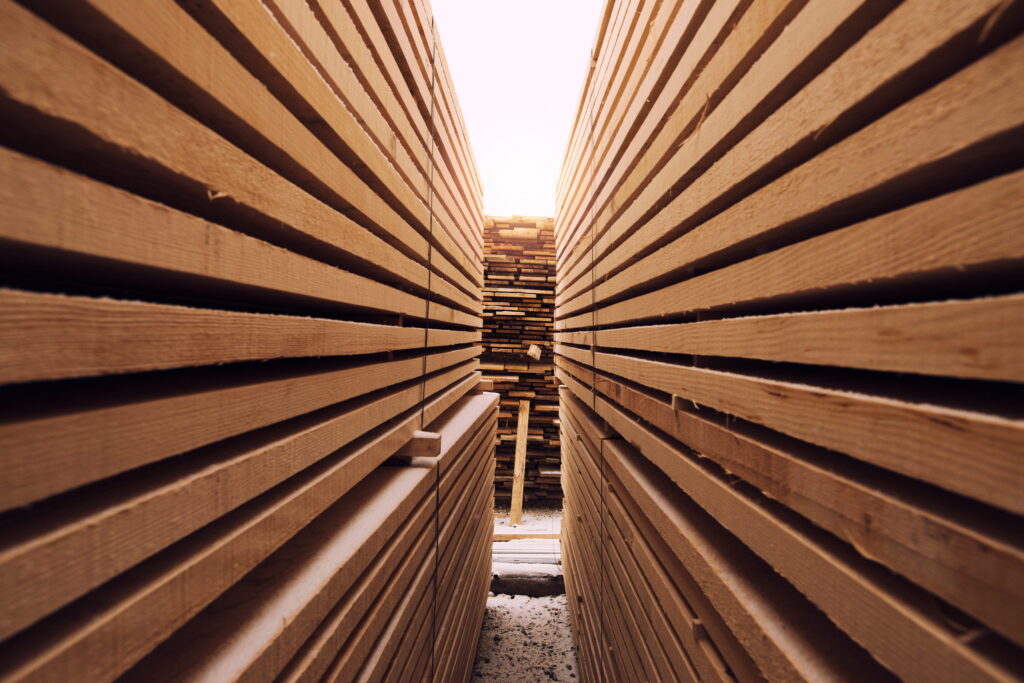
Lumber bundles can sit for weeks or months in an outdoor yard before they reach a jobsite, distributor, or customer. During that time, the strapping has to do more than hold boards together. It may be exposed to rain and humidity, changing temperatures, repeated forklift moves, settling lumber, and another round of handling when the bundle is finally shipped.
Those conditions should influence the type of strapping you purchase for lumber bundles.
For some applications, zinc-coated or galvanized steel may provide the combination of strength and corrosion resistance the yard needs. Other bundles may be better candidates for PET because the strap can accommodate some settling or dimensional change. Stainless steel is available for more demanding corrosive environments, while edge protection can help protect vulnerable bundle corners.
There is no single best strapping for outdoor lumber storage. The right choice depends on what happens to the bundle while it is sitting in the yard and what will happen to it afterward.
Outdoor Storage Can Change the Bundle Before It Ships
Lumber does not necessarily remain the same size from the day it is strapped until the day it leaves the yard.
The USDA Forest Products Laboratory’s current Wood Handbook, FPL-GTR-282, explains that wood tends toward a moisture content that is in equilibrium with the surrounding air. Seasonal moisture changes can lead to dimensional changes, while the moisture content of exterior wood is influenced by outdoor relative humidity and exposure to rain and sun.
For a strapped bundle, those changes matter. Boards that lose moisture may shrink or settle. Lumber that gains moisture can swell. Compression within the bundle can also change as it sits.
A steel strap does not automatically fail when that happens. But a strap applied tightly around the original bundle dimensions may no longer be holding exactly the same load weeks later.
Outdoor lumber yards also add mechanical stresses. Bundles may be unloaded, stacked, relocated, pulled for an order, and loaded onto a truck. Forklift contact, shifting boards, and damaged corners can all affect a strapping system that still looked fine when it first entered storage.
This is why outdoor lumber strapping should be selected for the storage cycle, not just the weight of the bundle on the day it is packaged.
Moisture Exposure Makes the Strap Finish Important
If a lumber yard is already finding rusted strapping on bundles, moving to a stronger version of the same unprotected material may not solve the underlying problem.
Champion Strapping manufactures specialty zinc-coated and galvanized steel strapping for applications involving humidity, outdoor yards, and longer-term exposure. Stainless steel strapping is also available when a higher level of corrosion resistance is needed. Champion’s standard painted and waxed steel strapping is positioned for more general storage and sheltered transportation conditions. Champion’s zinc-coated and galvanized strapping is also suited for applications requiring enhanced corrosion resistance, including outdoor storage and humid conditions.
There is good technical reason to consider the environment when specifying a zinc-coated product. As general background on hot-dip galvanized steel, the American Galvanizers Association explains that atmospheric performance is affected by temperature, humidity, rainfall, pollution, and air salinity. It also describes how hot-dip galvanized steel develops a protective zinc patina during natural wet-and-dry exposure cycles.
That AGA guidance applies specifically to hot-dip galvanized steel and should not be taken as a description of the exact process used for every Champion Strapping zinc-coated or galvanized strapping product. Champion can confirm the appropriate finish for the specific outdoor conditions in your yard.
Strength Still Matters After You Address Corrosion
A corrosion-resistant finish does not tell you whether the strap itself is strong enough. Bundle weight, lumber dimensions, the number and placement of straps, handling conditions, and transportation requirements all influence the specification. A dense timber bundle that will be moved repeatedly may call for a different grade than a lighter bundle sitting undisturbed in a protected portion of the yard.
For applications that need more strength, Champion offers regular-duty high-strength steel strapping made from cold-rolled mid-carbon steel. In some situations, it can provide a cost-effective alternative to heavy-duty strapping.
For lumber and building-material applications, Champion offers regular-duty steel strapping for light- to medium-duty loads and heavy-duty, heat-treated steel strapping for heavier timber, high-impact handling, and loads that may face rough transit conditions.
These figures show why specifying only “steel banding” is not enough:
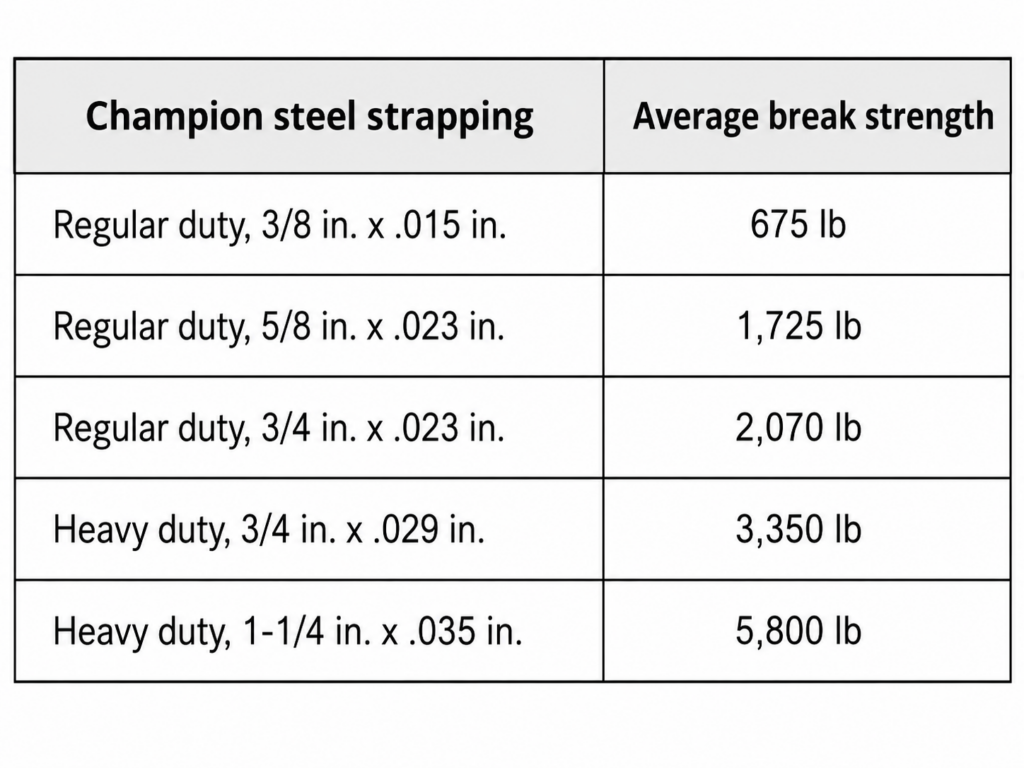
These examples show the range of steel strapping Champion Strapping offers. Your final strap width, thickness, grade, and quantity should be selected based on the size, weight, handling, and storage conditions of your lumber bundles.
PET Is Worth Considering When Lumber Settles or Changes Dimension
Steel has very little stretch, which is useful when a load needs firm containment. Lumber creates a different challenge because boards can dry, absorb moisture, compress, or settle while the bundle is stored.
Polyester, or PET, strapping can accommodate some of that movement. Champion’s PET strapping provides elongation recovery, shock absorption, and long-term tension retention while also resisting moisture and corrosion. Its ability to stretch and recover can help maintain tension as lumber bundles change slightly in size during storage or transportation. PET is also widely used for wood and lumber applications because its elongation and recovery can help the strap remain tight and absorb impacts.
PET is not automatically the right replacement for steel on every outdoor lumber bundle. Very heavy loads, severe handling, sharp contact points, or applications that require very low stretch may still call for a properly specified steel strapping system.
For extended outdoor storage, also confirm that the specific PET grade is suitable for the expected UV exposure, temperature range, and length of storage. Outdoor performance can vary from one PET product to another.
Stainless Steel for More Demanding Outdoor Conditions
Champion offers stainless steel strapping for applications where greater corrosion resistance and durability are needed. It may be worth considering when lumber will be stored in especially demanding environments, including areas with persistent moisture or exposure to corrosive contaminants.
Stainless steel is highly corrosion resistant, but it is not corrosion-proof. Performance can vary by stainless grade and by environmental factors such as moisture, chlorides, pollutants, and surface condition. Coastal salt and deicing salts can create more aggressive conditions.
For many inland lumber yards, zinc-coated or galvanized steel may be an appropriate place to start the conversation. Stainless steel becomes more relevant as the exposure becomes more severe.
Repeated Forklift Handling Can Affect Bundle Security
Lumber bundles often move several times before leaving the yard. A bundle may be unloaded, placed in storage, relocated, pulled for an order, and then loaded onto a truck. During those moves, a fork can contact a strap, boards can shift, and already-settled lumber can place new stresses on the strapping.
Inspect a bundle after significant impacts or unusual handling. A damaged strap, shifted boards, crushed corners, or a strap that is no longer in firm contact with the lumber can indicate that the bundle needs attention before it is moved again.
If steel strapping needs to be re-tensioned, removed, or replaced, make sure trained personnel use the correct tools and protective equipment. Champion recommends safety glasses, cut-resistant gloves, control of loose strap ends, properly matched tools and seals, and keeping personnel out of the line of a tensioned strap.
Protect the Bundle Where the Strap Meets the Corner
The corners of a lumber bundle can experience considerable pressure when strapping is tensioned.
Edge boards and edge protectors can help reinforce these vulnerable contact points and reduce damage during handling and transportation. They may be especially useful when:
- High strap tension is required.
- Bundle corners are being crushed.
- Finished or softer lumber surfaces need protection.
- Bundles are handled repeatedly.
- The strap is cutting into or deforming the corner.
Edge protection works with the strapping system. It does not replace the need to choose the correct strap width, thickness, strength, and material for the load.
A Quick Starting Point for Outdoor Lumber Strapping
Use the table below to identify the main problem you are trying to solve before discussing your application with Champion Strapping.
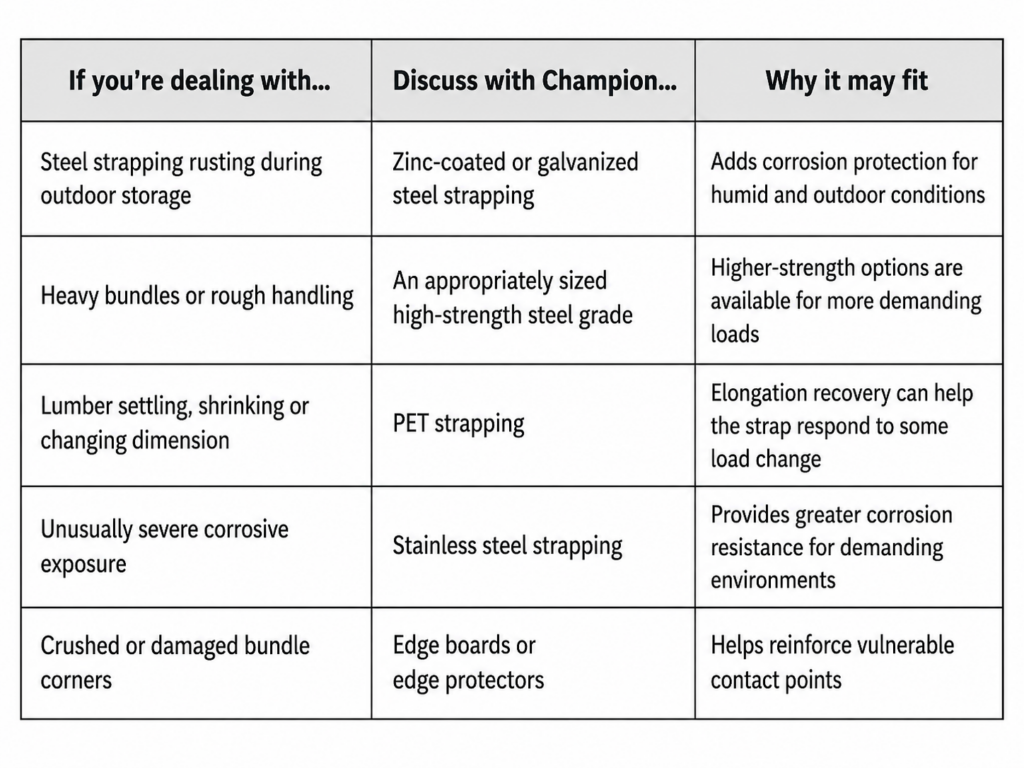
Your application may involve more than one of these problems. For example, a heavy bundle stored outdoors may benefit from both a corrosion-resistant steel finish and edge protection.
What Is the Best Strapping for Lumber Stored Outdoors?
The best strapping for lumber stored outdoors depends on the bundle weight, storage duration, moisture exposure, handling conditions, and how much the lumber may settle or change dimension.
Zinc-coated or galvanized steel can be a good option when you need steel’s strength and low stretch along with better corrosion resistance for outdoor exposure.
PET may be worth considering when the lumber is likely to settle or change dimension and maintaining tension through that movement is important.
Stainless steel is available for more demanding corrosive environments.
The final specification should include the appropriate strap width, thickness, strength, and finish for your load rather than simply calling for “steel strapping for lumber.”
What Type of Strapping Resists Rust?
Zinc-coated or galvanized steel, stainless steel, and PET can all help address rust concerns, but they do so differently.
Zinc-coated or galvanized steel uses a protective finish to improve the corrosion resistance of steel.
Stainless steel provides a higher level of inherent corrosion resistance, although the grade still needs to suit the environment.
PET is a polymer, so it does not rust.
Your best choice will depend on whether corrosion is the main concern or whether the bundle also needs the strength, low stretch, or impact resistance associated with a particular strapping material.
Can PET Strapping Be Used for Outdoor Lumber Storage?
Yes, PET can be considered for outdoor lumber applications, especially when the bundle may settle or change dimension, and the strapping needs elongation recovery and good tension retention. PET also resists moisture and corrosion, which can make it useful in environments where rust is a concern.
For longer outdoor storage periods, confirm that the specific PET grade is suitable for the amount of UV exposure, temperature variation, and storage time expected at your facility.
When Should a Lumber Yard Consider Stainless Steel Strapping?
Stainless steel is worth discussing when your outdoor storage conditions create a more demanding corrosion problem than ordinary yard exposure. Persistent moisture, salt, or other corrosive contaminants may justify considering stainless steel. The correct grade still needs to be matched to the environment, since stainless products do not all perform identically under outdoor exposure.
Tell Champion Strapping How Your Lumber Is Actually Stored and Handled
The more our team knows about your application, the more useful our strapping recommendation can be.
When you contact us, be ready to provide:
- Your approximate bundle dimensions and weight.
- How long the lumber normally stays outdoors.
- How much rain, humidity, or other moisture exposure it receives.
- How often bundles are moved by forklift.
- How the lumber will be transported after storage.
- The strapping and tooling you currently use.
- Any problems you are trying to correct, such as rust, loose straps, breakage, or corner damage.
With that information, we can help you evaluate the appropriate strap material, grade, strength and finish, along with edge protection where it makes sense.
Ask Champion Strapping to recommend a strapping system based on your lumber bundle size, outdoor storage duration, moisture exposure, and transportation conditions.